Cameron Batts

Turning Data Into Decisions

Senior Healthcare Operations Manager

15+ years leading healthcare and military operations, now applying that operational lens to analytics. I build dashboards, models, and decision tools grounded in how leaders actually use data, not just how it is reported.

This portfolio reflects that shift, with Projects across Power BI, Tableau, R, Python, SQL, and SAS Viya, each focused on a real problem, the approach taken, and the insights produced. Open to roles in data and visual analytics.

PMP · SAS Visual Analytics Certified · MSQM Duke Fuqua · MBA Illinois Gies · Active Duty USAF
Technical Skills

Tools used to clean, analyze, and visualize data to support decision making across operations and healthcare environments.

Power BI Tableau Python R SQL SAS Viya Excel Machine Learning Data Visualization

Project Library

R · Statistical Analysis · Fraud Detection

Benford's Law Analysis: 2009 Iranian Election Data


Problem
Following the 2009 Iranian presidential election, widespread allegations of voter fraud prompted protests across the country. The question was whether reported vote totals showed statistical patterns inconsistent with naturally occurring numbers.
Approach
Applied Benford's Law in R using the benford.analysis package to analyze the leading digit distribution of total vote counts across all regions. Cleaned and tidied the raw election CSV, then ran a chi-squared goodness-of-fit test to quantify deviation from expected distributions.
Impact
The chi-squared test produced a p-value of 0.4741, indicating vote totals did not significantly deviate from Benford's Law, providing a statistically grounded perspective on the fraud allegations using mathematical forensics.
R · Regression · Outlier Detection

Housing Market Outlier Detection & Regression Analysis


Problem
Housing sale price data contained missing values, anomalous records, and potential outliers that could distort predictive model accuracy before and after the 2009 market shift.
Approach
Built linear regression models in R on Ames housing data split by pre and post-2009 periods. Conducted NA analysis across 82 variables, applied outlier detection using diagnostic plots, and evaluated model fit with adjusted R-squared and residual analysis.
Impact
Achieved an adjusted R-squared of 0.86 on the post-2009 model, identifying neighborhood, exterior quality, and floor square footage as significant price drivers and flagging outlier properties with anomalous sale prices for further review.
R · Decision Trees · Machine Learning

Loan Default Prediction via Decision Trees


Problem
Loan default data was heavily imbalanced, causing naive models to fail at detecting defaults and limiting the usefulness of predictions for risk management decisions.
Approach
Built a decision tree in R using rpart, addressing class imbalance through balanced sampling and a custom loss matrix to penalize missed defaults. Pruned the tree using cross-validation to reduce overfitting and improve generalizability.
Impact
Produced an interpretable pruned tree that improved detection of high-risk borrowers, enabling more targeted risk classification and supporting more informed lending decisions.
R · Logistic Regression · Classification

Loan Default Prediction via Logistic Regression


Problem
Lenders needed a statistically grounded model to identify borrowers at risk of default using credit grade, income, employment history, and age data.
Approach
Applied logistic regression in R to classify loan default risk, performing exploratory analysis across key variables, removing outliers, and evaluating model performance using cross-tabulation and coefficient interpretation.
Impact
Identified credit grade and income as the strongest predictors of default, producing a model that supported more data-driven and transparent lending risk assessments.
R · Anomaly Detection · EDA

NYC Flight Delay & Anomaly Detection


Problem
Airlines and airports needed to understand which weather conditions were most strongly associated with flight delays and cancellations across New York City airports.
Approach
Analyzed 336,776 flights from the nycflights13 dataset in R, joining flight and weather data to examine relationships between delays, cancellations, and conditions including visibility, wind speed, precipitation, and temperature.
Impact
Surfaced that low visibility and high wind gusts were the strongest weather-related delay drivers, providing actionable patterns to support operational planning and delay mitigation decisions.
R · Time Series · ARIMA · VAR · Forecasting

Housing Price Forecasting via Time Series & VAR Analysis


Problem
Housing market analysts needed to forecast U.S. home price growth using historical price data and exogenous drivers like housing starts, while accounting for seasonality, non-stationarity, and temporal persistence in the series.
Approach
Pulled monthly S&P/Case-Shiller Home Price Index and housing starts data from the FRED API (1987-2023). Applied ARIMA modeling with bootstrapped bagging and a Vector Autoregression (VAR) to capture simultaneous relationships between prices and starts. Performed Granger causality testing and Impulse Response Function analysis.
Impact
Found that housing starts Granger-cause price growth with effects peaking within 2-3 months and dissipating within 1.5-2 years. Bagging improved upon the baseline ARIMA forecast by reducing both parameter and model uncertainty.
Python · LASSO · Regularization

LASSO Feature Selection & Regression Pipeline


Problem
With 100 predictors in a dataset where only 10 are truly relevant, standard regression models overfit by including noise variables, reducing reliability and interpretability.
Approach
Built a LASSO regression pipeline in Python using scikit-learn with StandardScaler and GridSearchCV to tune the regularization parameter across 50 candidate values via cross-validation.
Impact
The model precisely identified all 10 relevant predictors and set the remaining 90 coefficients to zero, demonstrating how regularization improves model parsimony and supports more interpretable, production-ready predictions.
Python · SVM · Feature Engineering

SVM Classification with Kernel Trick & Feature Engineering


Problem
Two-class data arranged in a radial pattern was not linearly separable, causing logistic regression to achieve only 58.9% accuracy, well below a useful decision threshold.
Approach
Compared an RBF kernel SVM with gamma tuning via GridSearchCV against logistic regression. Also engineered a radial distance feature (x3) to make the classes linearly separable without a kernel, achieving perfect separation.
Impact
Both the SVM and the feature-engineered logistic model achieved 100% accuracy and precision, demonstrating the value of kernel methods and domain-driven feature engineering for non-linear classification problems.
Python · AdaBoost · Random Forest

Bank Marketing Campaign Prediction & Profit Optimization


Problem
A bank needed to identify which customers were likely to subscribe to a term deposit following a marketing campaign, maximizing campaign profitability rather than just prediction accuracy.
Approach
Compared AdaBoost, Decision Tree, and a tuned Random Forest using a custom value function optimized for marketing profit. Applied one-hot encoding, train/test splitting, and 5-fold GridSearchCV on the Random Forest.
Impact
The tuned Random Forest generated $57,190 in predicted marketing profit, outperforming AdaBoost by 317% and the Decision Tree by 143%, directly demonstrating the business value of model selection and tuning.
Python · K-Means · Clustering · PCA

Mall Customer Segmentation via Clustering


Problem
Retail marketers needed to segment mall shoppers into meaningful groups based on age, income, and spending behavior to support targeted marketing strategies.
Approach
Applied K-Means and hierarchical (agglomerative) clustering in Python, tuning the number of clusters using Calinski-Harabasz, Davies-Bouldin, and Silhouette scores. Used PCA for dimensionality reduction and visual validation.
Impact
All three scoring metrics agreed on an optimal k of 6, producing distinct customer segments that provided actionable groupings for targeted campaign planning and resource allocation.
Python · Linear Regression · Logistic Regression · Classification

Regression Interpretation, Classification Metrics & Advertising Prediction


Problem
Business analysts needed to interpret regression coefficients in real-world terms, evaluate classification model performance beyond simple accuracy, and predict sales outcomes from marketing spend data.
Approach
Applied linear and logistic regression to used car pricing and bank marketing datasets. Interpreted exponentiated coefficients, computed a full confusion matrix including accuracy, precision, recall, and specificity, and built a simple linear regression model to predict sales from Facebook advertising budget.
Impact
Demonstrated that a one-year increase in model year is associated with a 12.5% increase in selling price, and that Facebook ad spend explains approximately 94.6% of variation in sales, providing actionable insight for pricing strategy and marketing budget allocation.
Python · pandas · EDA · GroupBy

Retail Sales & Store Performance Analysis


Problem
Retail sales data across 45 stores of varying types and sizes needed to be cleaned, merged, and analyzed to surface performance differences and support inventory and staffing decisions.
Approach
Used Python and pandas to merge sales and store datasets, engineer store size categories, and apply GroupBy with method chaining to summarize weekly sales by store type, department, and holiday status.
Impact
Found that Type A stores averaged $1.37M in weekly sales versus $816K for Type B and $472K for Type C, providing clear evidence that store type is a major driver of revenue and should inform resource allocation decisions.
Power BI Healthcare Dashboard Power BI · Healthcare Analytics · Workforce Planning

Healthcare Operations & Workforce Analytics Dashboard


Problem
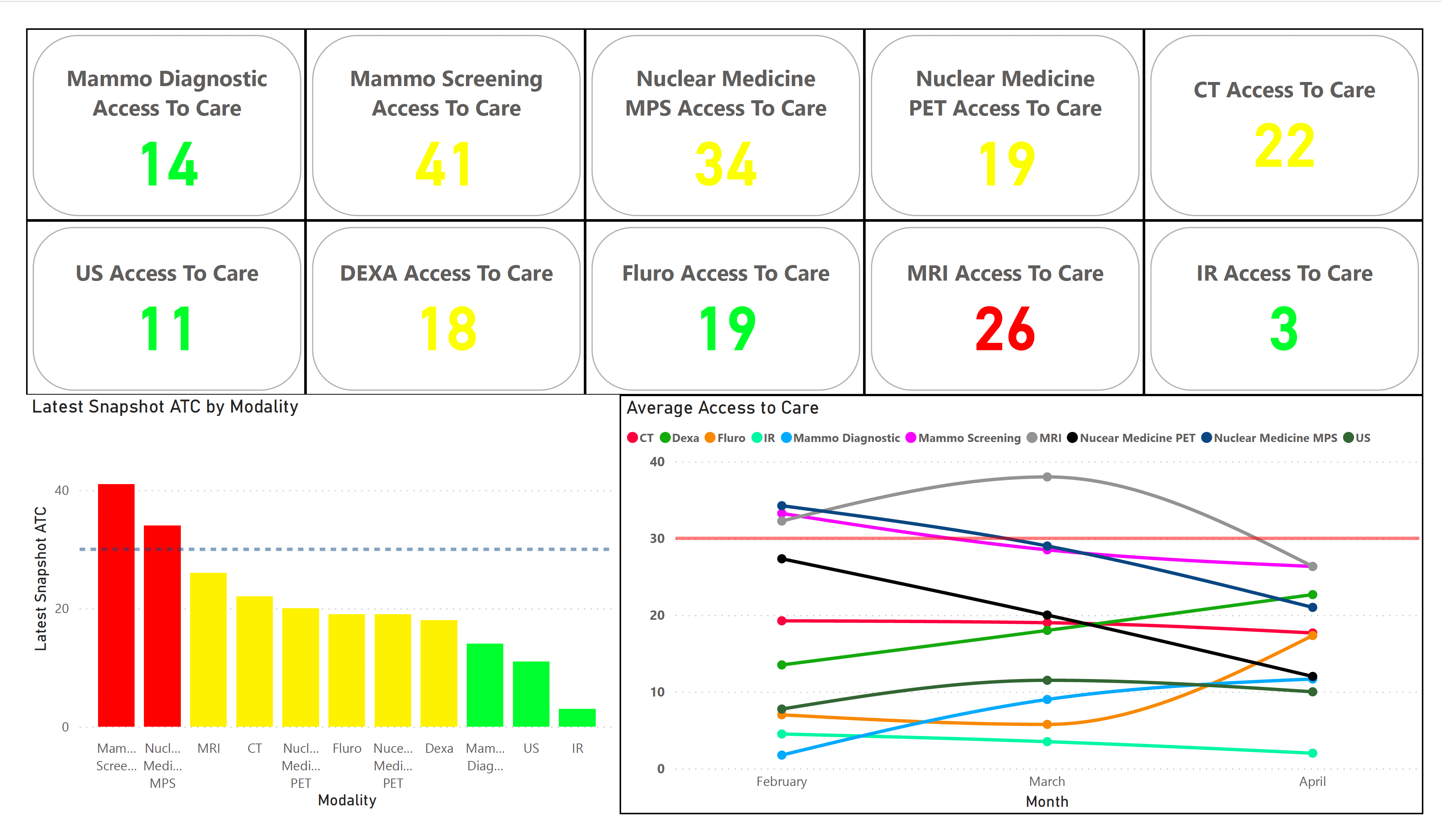
Senior leadership at David Grant Medical Center lacked real-time visibility into personnel readiness, SEI qualification coverage, deployment status, and access to care across 7 imaging departments serving 276,000+ patients annually.
Approach
Developed Power BI dashboards integrating personnel, SEI qualification, deployment, and access-to-care data across MRI, CT, Mammography, IR, and Nuclear Medicine to surface operational gaps for leadership.
Impact
Enabled data-driven staffing, throughput, and resource allocation decisions for senior leadership overseeing 36,000 diagnostic procedures and $6.4M in clinical operations.
Tableau Sales Dashboard Tableau · Sales Analytics · Data Visualization

North American Sales & Customer Analytics Dashboard


Problem
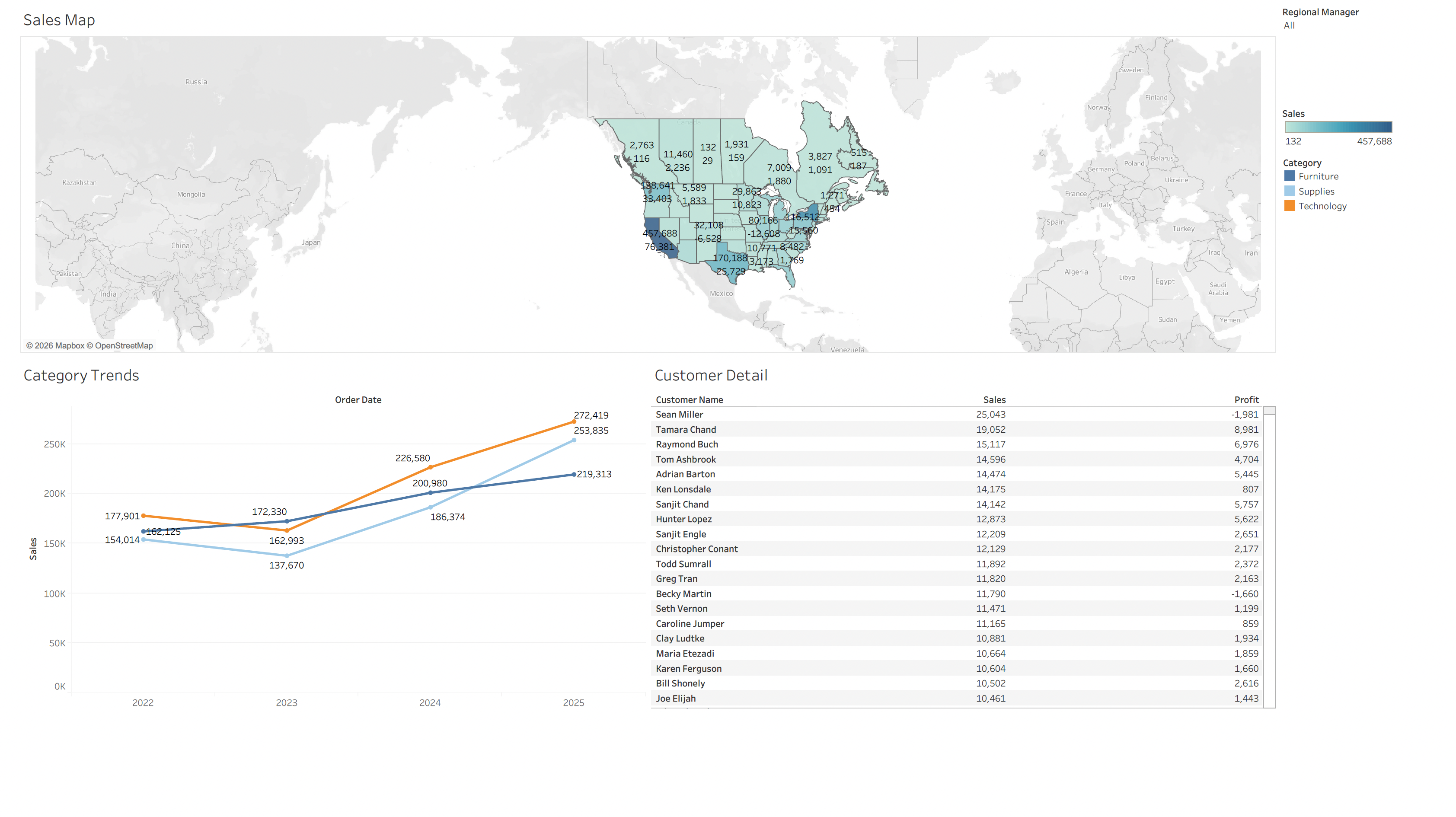
Sales leadership lacked a unified view of regional performance, category trends, customer profitability, and shipping compliance across North American markets spanning four regions and three product categories.
Approach
Built a multi-tab Tableau dashboard featuring an interactive geographic sales map, category trend lines across 2022 to 2025, customer-level sales and profit breakdowns, regional drill-downs for West, Central, South, and East, and a product-level shipping performance tracker flagging items exceeding delivery targets.
Impact
Enabled leadership to identify that Technology was the top-performing category at $272K in peak quarterly sales, pinpoint the West region as the highest revenue driver at $457K, and surface individual customers with negative profit margins requiring account review, supporting faster and more targeted sales decisions.

SQL projects coming soon.

SAS US Aviation Industry Trends SAS Viya · Visual Analytics · Industry Trends

U.S. Aviation Industry Trends Analysis


Problem
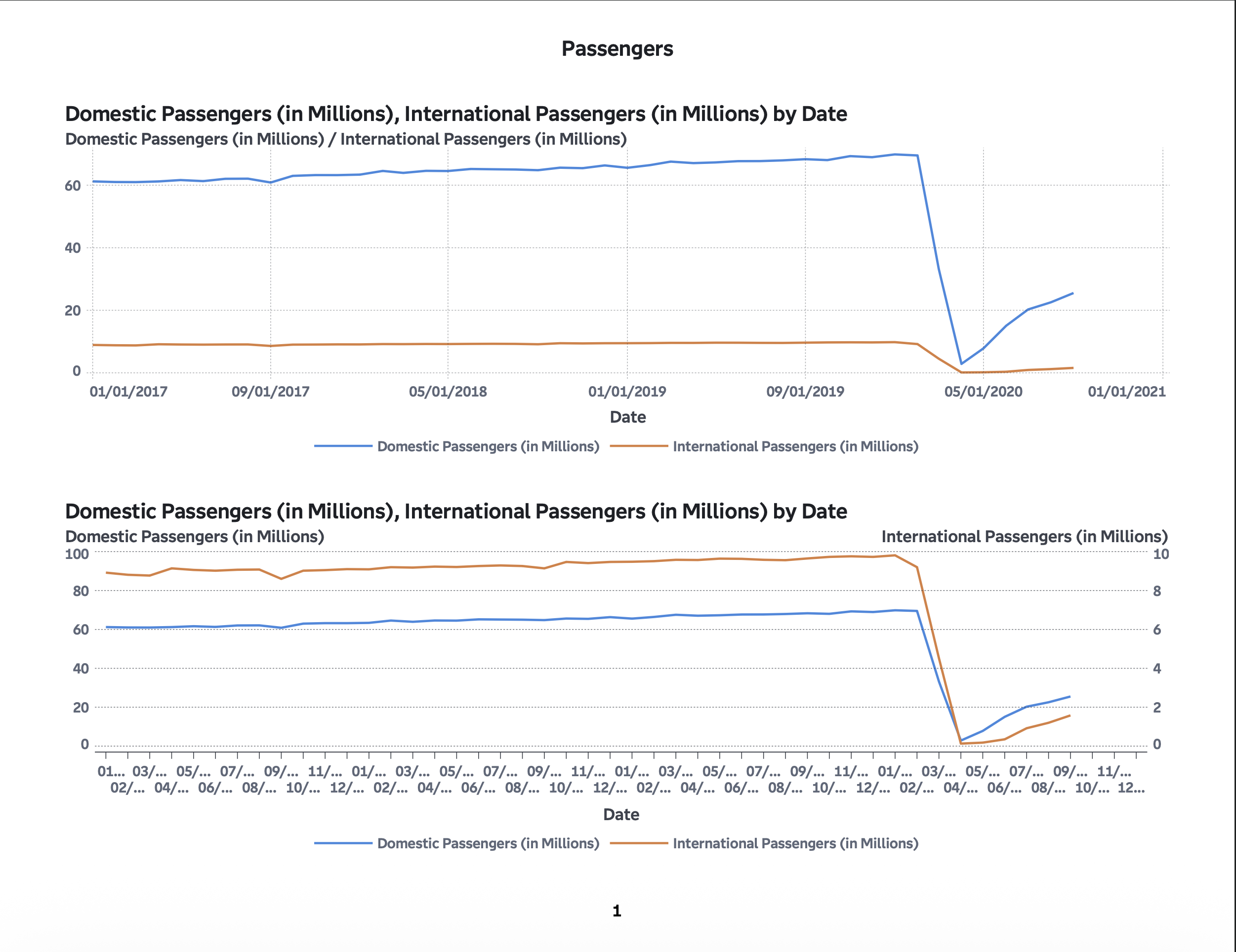
Aviation industry stakeholders needed a unified view of how passenger volume, workforce levels, financial performance, and operating costs shifted across the 2017-2021 period, including the sharp disruption caused by COVID-19 in 2020.
Approach
Built a multi-page SAS Viya report covering domestic and international passenger trends, time series forecasting with confidence intervals, FTE workforce tracking by airline and carrier group, quarterly profit/loss breakdowns, and a year-over-year revenue and expense change analysis across all route types.
Impact
Surfaced the scale of the 2020 collapse in both domestic and international travel, revealed recovery trajectories through 2021, and enabled side-by-side comparison of operating revenue versus expense changes across all route categories to support strategic planning decisions.
SAS Megacorp Acquisition Analysis SAS Viya · Visual Analytics · Acquisition Analytics

Megacorp Acquisition Analysis


Problem
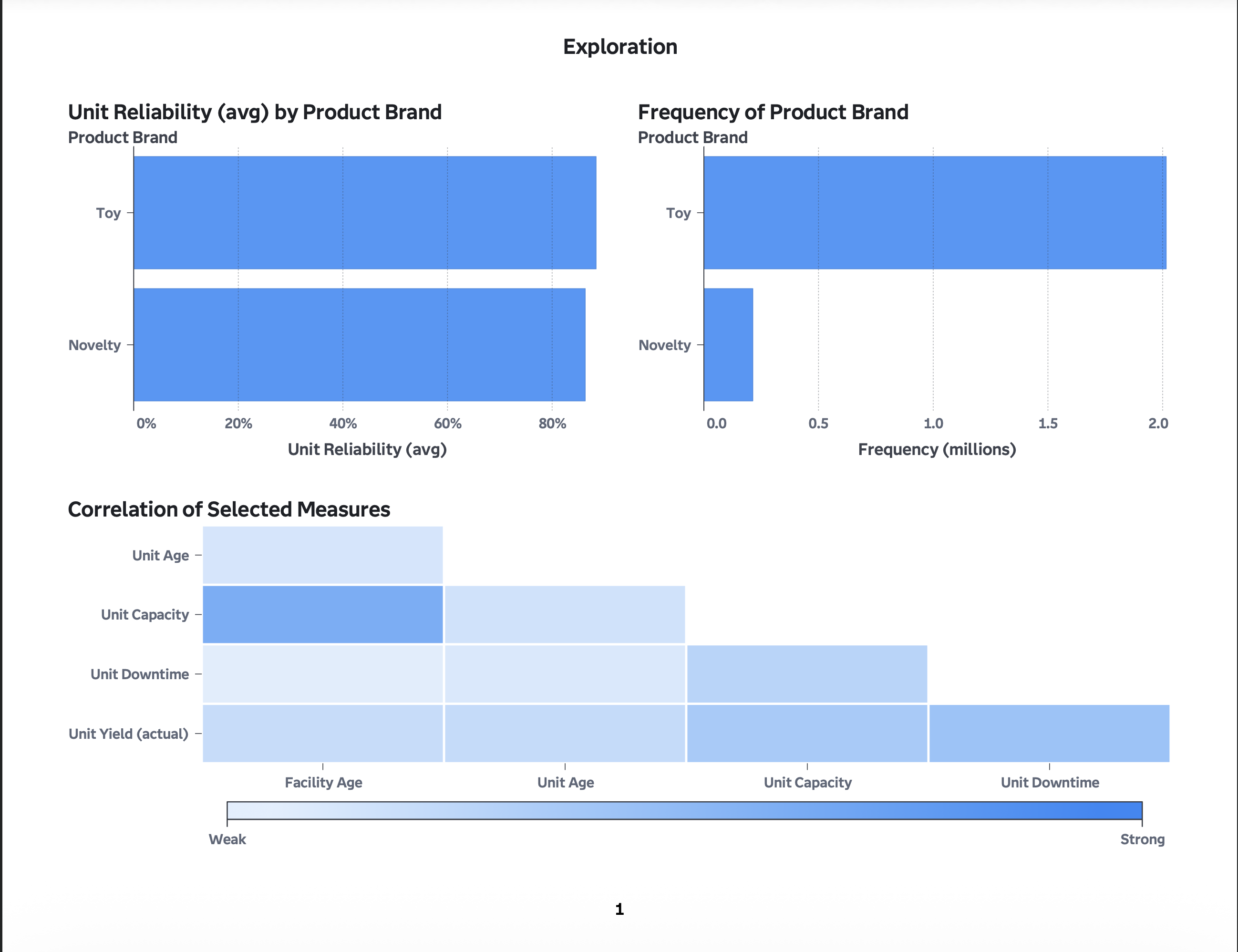
Decision makers evaluating a potential acquisition needed a clear picture of target company product reliability, facility footprint across U.S. regions, and profitability trends by product line to support a data-driven acquisition assessment.
Approach
Built a SAS Viya report across three analytical sections: an exploration page with correlation matrices and unit reliability comparisons by product brand, a geography page mapping 12 facilities across North, South, East, and West regions, and a profit analysis page with year-selectable KPIs, product line profit breakdowns, and a 2015-2018 profit trend line.
Impact
Revealed $51M in total 2018 profit with Games and Promotional lines driving positive returns while Action Figure and Stuffed Animal lines carried losses, and surfaced a declining profit trend from $4.9M in 2015 to $972K in 2018, giving leadership the financial visibility needed to evaluate acquisition risk and product line strategy.
SAS Insight Toys Report SAS Viya · Visual Analytics · Operations

Insight Toys Product & Unit Production Analysis


Problem
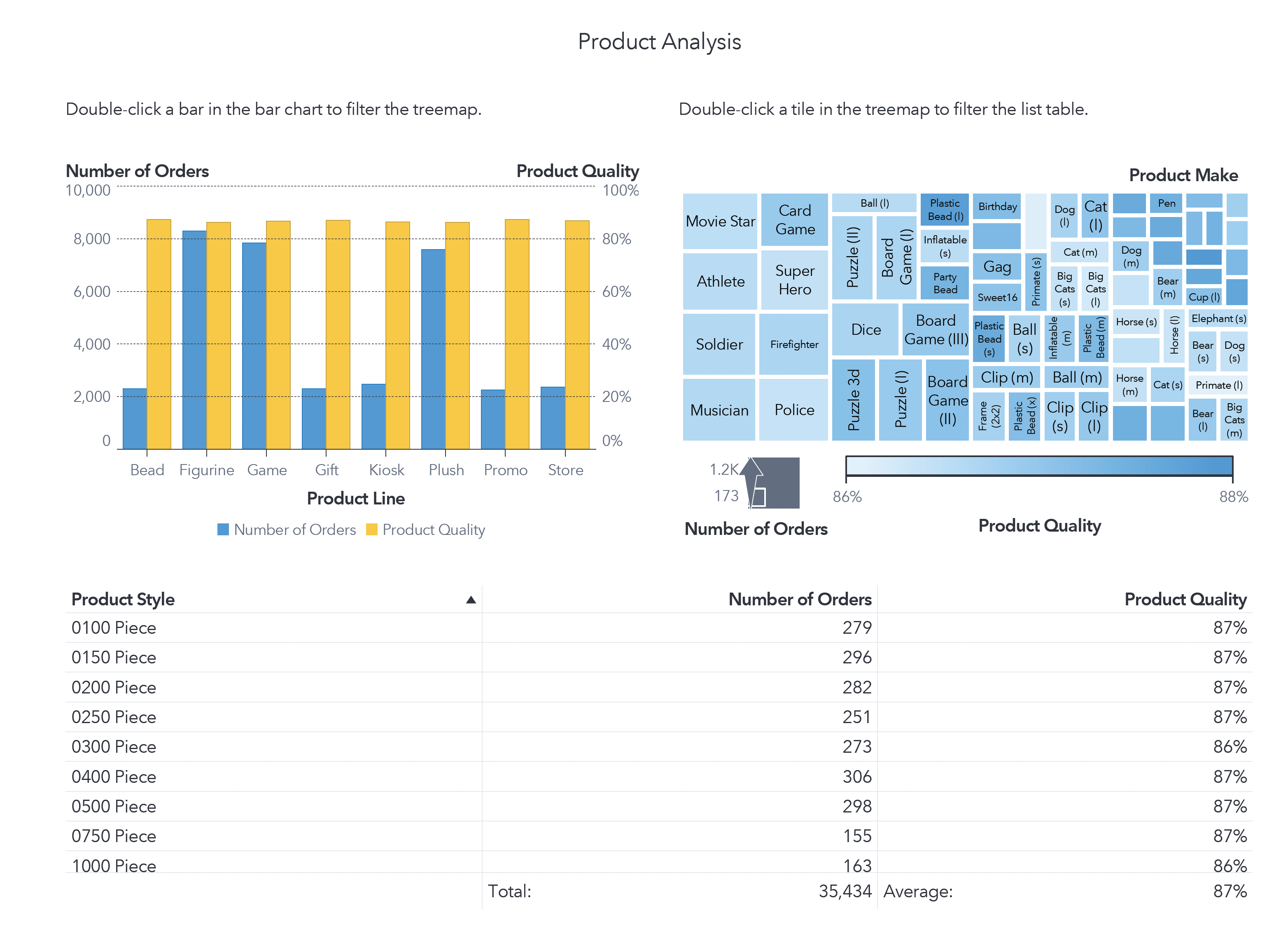
Insight Toys needed a unified executive report to track product performance, customer satisfaction trends, and manufacturing yield rates across product lines and global facilities.
Approach
Developed a multi-page SAS Viya report covering an overview dashboard, product quality analysis by product line, and a unit production tracker monitoring yield rates, discards, and production targets across 18 facility units.
Impact
Identified an average yield rate of 90% against a 4.3M unit target, flagged units falling below 50% yield for immediate review, and enabled product managers to drill into quality performance by product style supporting faster operational decisions.
SAS Sports Product Report SAS Viya · Visual Analytics · Product Analytics

Sports Product Line Performance Analysis


Problem
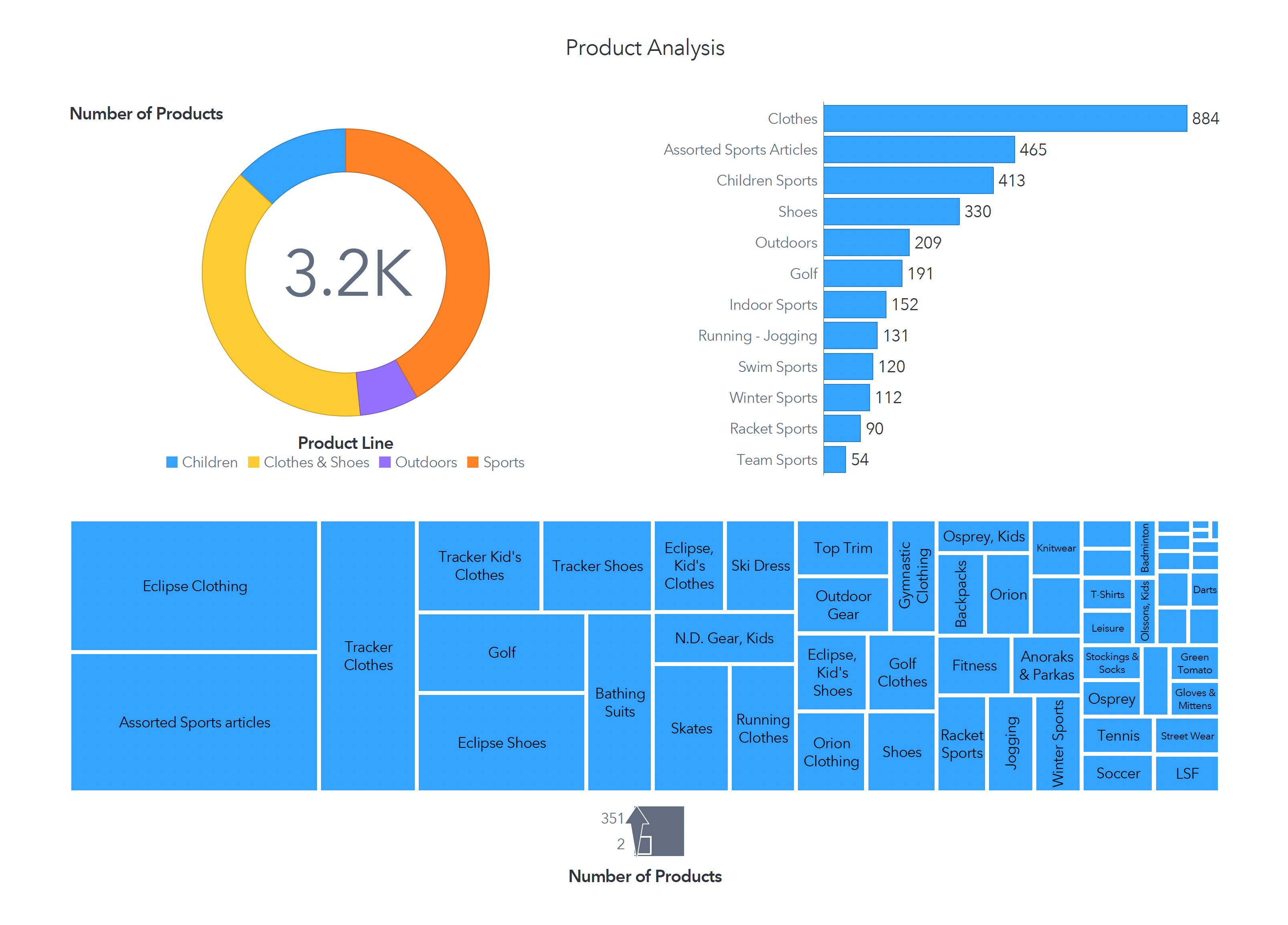
Product and category managers needed a clear view of how 3,200+ sports products were distributed across product lines and which categories drove the most volume to inform inventory and assortment decisions.
Approach
Built a SAS Viya pop-up page report with product line breakdowns across Children, Clothes & Shoes, Outdoors, and Sports, visualizing product counts by category and surfacing top product groups using interactive treemap and bar chart navigation.
Impact
Identified Clothes as the largest product group at 884 products and revealed that Children and Sports lines carried the broadest assortment, enabling more targeted inventory planning and category management decisions.
SAS Customer Retail Analysis SAS Viya · Visual Analytics · Customer Analytics

European Customer & Retail Sales Analysis


Problem
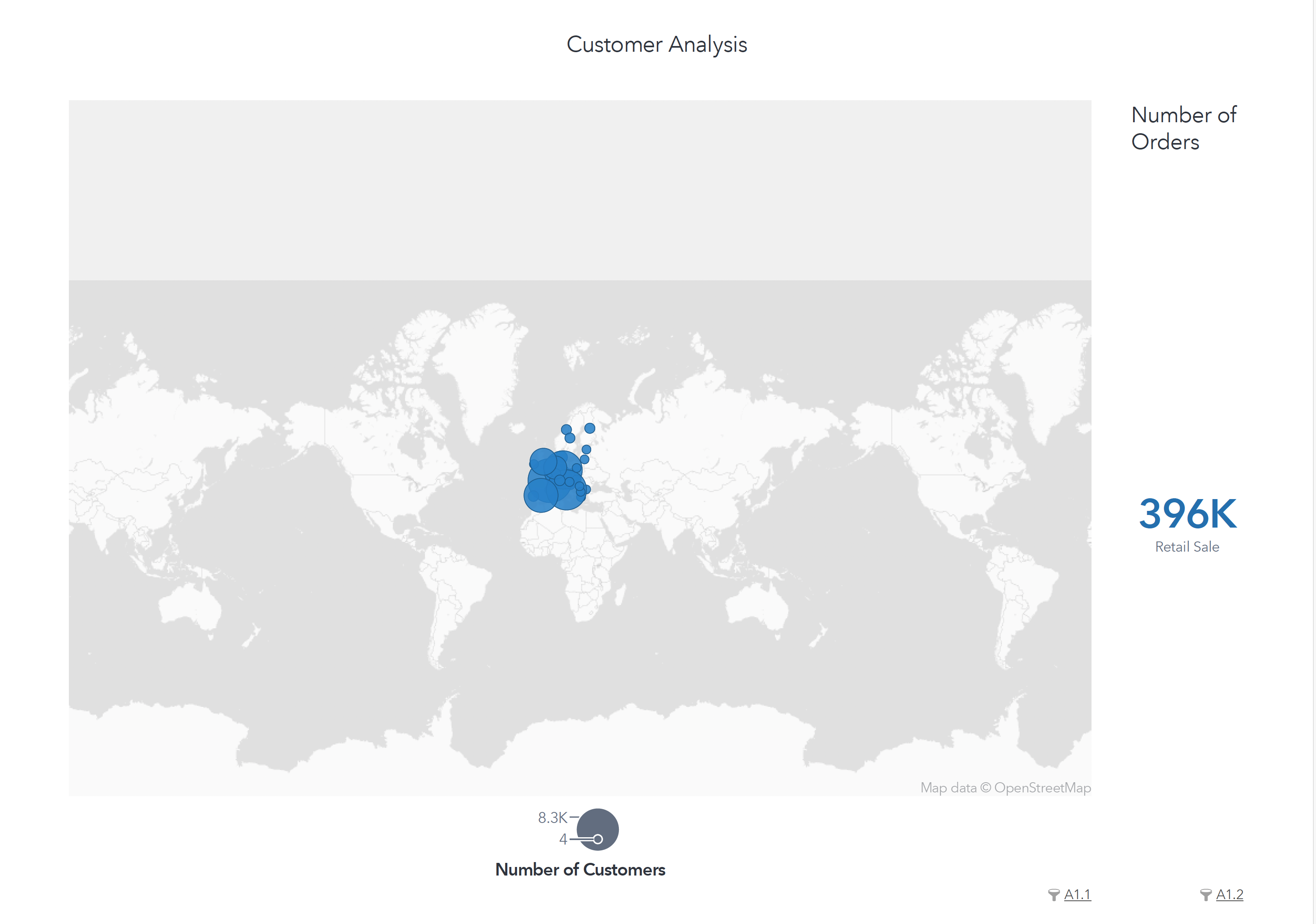
Retail leadership needed visibility into customer distribution and order volume across European markets to understand geographic concentration and total retail sales performance.
Approach
Built a SAS Viya report featuring an interactive geographic bubble map of customer counts by country filtered to Europe, paired with KPI tiles displaying total customers and aggregate retail sales.
Impact
Surfaced 8,300 customers across European markets generating 396K in retail sales, enabling leadership to identify geographic concentration and prioritize market development efforts.
SAS Facility Products Report SAS Viya · Visual Analytics · Supply Chain

Sports Supplier & Facility Products Analysis


Problem
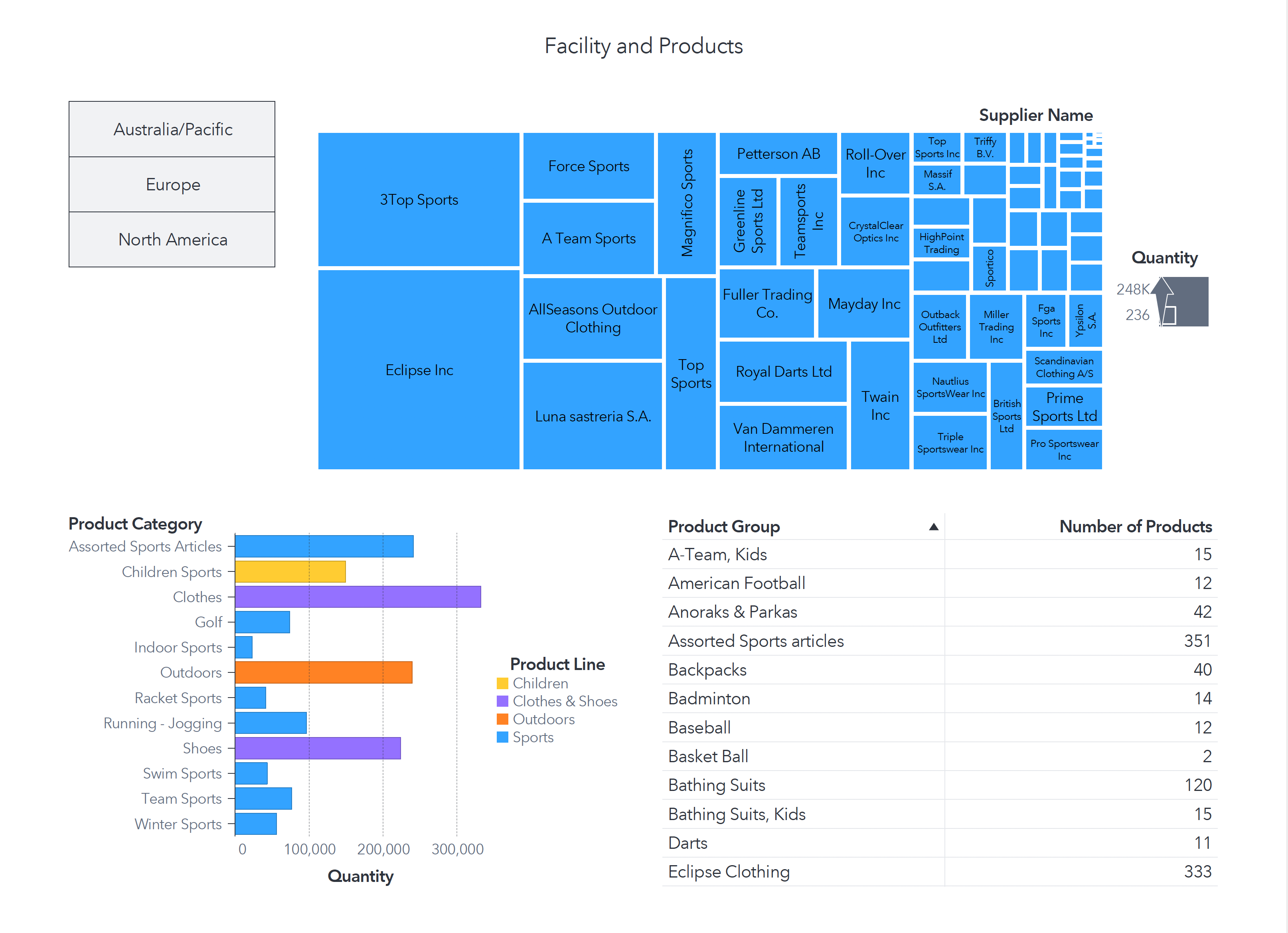
Supply chain and product managers needed a unified view of supplier networks, product line distribution, and quantity across global facilities in Australia/Pacific, Europe, and North America.
Approach
Built a SAS Viya report mapping 33 suppliers across three global regions, with product category breakdowns by quantity and product line, and a product group table surfacing item counts across Children, Clothes & Shoes, Outdoors, and Sports lines.
Impact
Surfaced 248K units in quantity across product categories, identified Assorted Sports Articles and Children Sports as the highest volume categories, and enabled supply chain managers to visualize supplier concentration by region for sourcing decisions.

Connect

Open to connecting on data analytics, healthcare operations, and opportunities focused on data driven decision making.